


Social division, racism, and prejudice
Social division, racism, and prejudice in Israeli society weaken the social fabric, deepen divides between groups, and undermine the dignity, sense of belonging, and safety of individuals and communities.

Education System
In the education system, stereotypes, prejudice, and racism do not remain outside the school gates. They enter daily interactions among students, shaping their sense of belonging and the overall group climate. In a context of growing social division, educators play a central role in creating safe, inclusive, and respectful environments that foster connection, critical thinking, and the ability to see others beyond labels and generalizations.
Matzmichim Academy works in partnership with the Administration for Civic Education and Coexistence at the Israeli Ministry of Education, as well as the Government Unit for the Coordination of the Struggle Against Racism at the Ministry of Justice. It delivers experiential workshops for students alongside professional training for educational staff, equipping them with practical tools to reduce prejudice and racism, facilitate meaningful dialogue, and foster a more equal, safe, and inclusive educational environment.
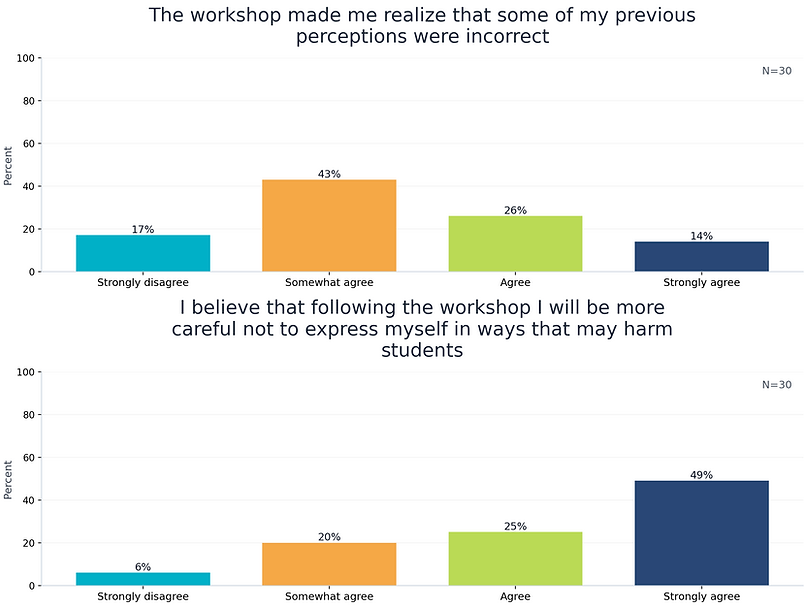
Students feedback:
Teachers feedback:

The workshop helps challenge and disrupt existing prejudices
The workshop has a strong impact on teachers’ ability to address prejudice and racism

Government Ministries and Organizations
Racism, prejudice, and lack of inclusion based on origin, religion, or culture- as well as feelings of invisibility and unequal opportunity- can harm employees, weaken organizational climate, and affect performance across the organization.
Matzmichim Academy works in partnership with the Office of the National Coordinator for Combating Racism and provides training for professionals responsible for addressing racism across government ministries.
At the same time, Matzmichim delivers workshops for teams and managers in companies, organizations, and public authorities, equipping them with practical tools to reduce prejudice and exclusion, and to build inclusive work environments that respect cultural, gender, and religious diversity while strengthening a sense of belonging and collaboration.
More than 85% of participants reported gaining practical tools they can apply in their roles as supervisors.
More than 85% also reported a very high level of satisfaction with the course delivery.

“The Matzmichim workshop provides significant value to the players, particularly in fostering awareness and prevention of racist remarks or behaviors- both within the club and beyond. This is one of the most important values: learning to respect one another."
(Head of Youth Department, Hapoel Tel Aviv)

Our Partners


.jpeg)


Our work in the media

Sports Groups
Racism has no place in sports- neither in the stands, on the field, nor within teams. In recent years, we have seen a troubling rise in racist expressions in sports arenas, from chants in the stands to hateful comments and posts on social media.
Racism harms not only athletes, but also the broader social fabric, undermining the core values of sport: equality, fairness, and team unity. Within teams, players from diverse backgrounds, languages, and cultures come together, and when prejudice takes hold, it can lead to tension, exclusion, weakened cohesion, and, at times, violence.
Matzmichim Academy works in partnership with the Government Unit for the Coordination of the Struggle Against Racism at the Ministry of Justice to deliver workshops for professional teams, national squads, and fan communities, in collaboration with clubs and public institutions.
“The Matzmichim workshop provides significant value to the players, particularly in fostering awareness and prevention of racist remarks or behaviors- both within the club and beyond. This is one of the most important values: learning to respect one another."
(Head of Youth Department, Hapoel Tel Aviv)
Our Partners
Our work in the media
"The Matzmichim workshop provides significant value to the players, particularly in fostering awareness and prevention of racist remarks or behaviors- both within the club and beyond. This is one of the most important values: learning to respect one another."
-Head of Youth Department, Hapoel Tel Aviv

Our Partners


Our work in the media
.jpg)
Haifa, Beitar, and Be’er Sheva volunteered to take part in a project aimed at eradicating racism.

A new initiative to reduce racism in youth teams: The Ministries of Justice and Education have launched a joint effort to promote equality in middle schools, delivering experiential workshops. “This is an integral part of our educational commitment.”

Dudi Amsalem delivered a speech to the youth players of Beitar Jerusalem on the importance of tolerance.

Working with the Israel Defense Forces
IDF units reflect the rich multicultural diversity of Israeli society, bringing together soldiers from different sectors, languages, cultures, and identities. A respectful and inclusive environment is not only a core value- it is essential for the well- being of each soldier and for building trust, cohesion, and operational effectiveness.
In recent years, rising social tensions have also been reflected within the military environment. Soldiers report experiences of exclusion, offensive comments or jokes, or unequal treatment based on background, culture, or identity.
Matzmichim Academy offers workshops for soldiers and commanders, equipping them with practical tools to address prejudice and racism, and to foster a culture of respect, inclusion, and shared responsibility within their units.